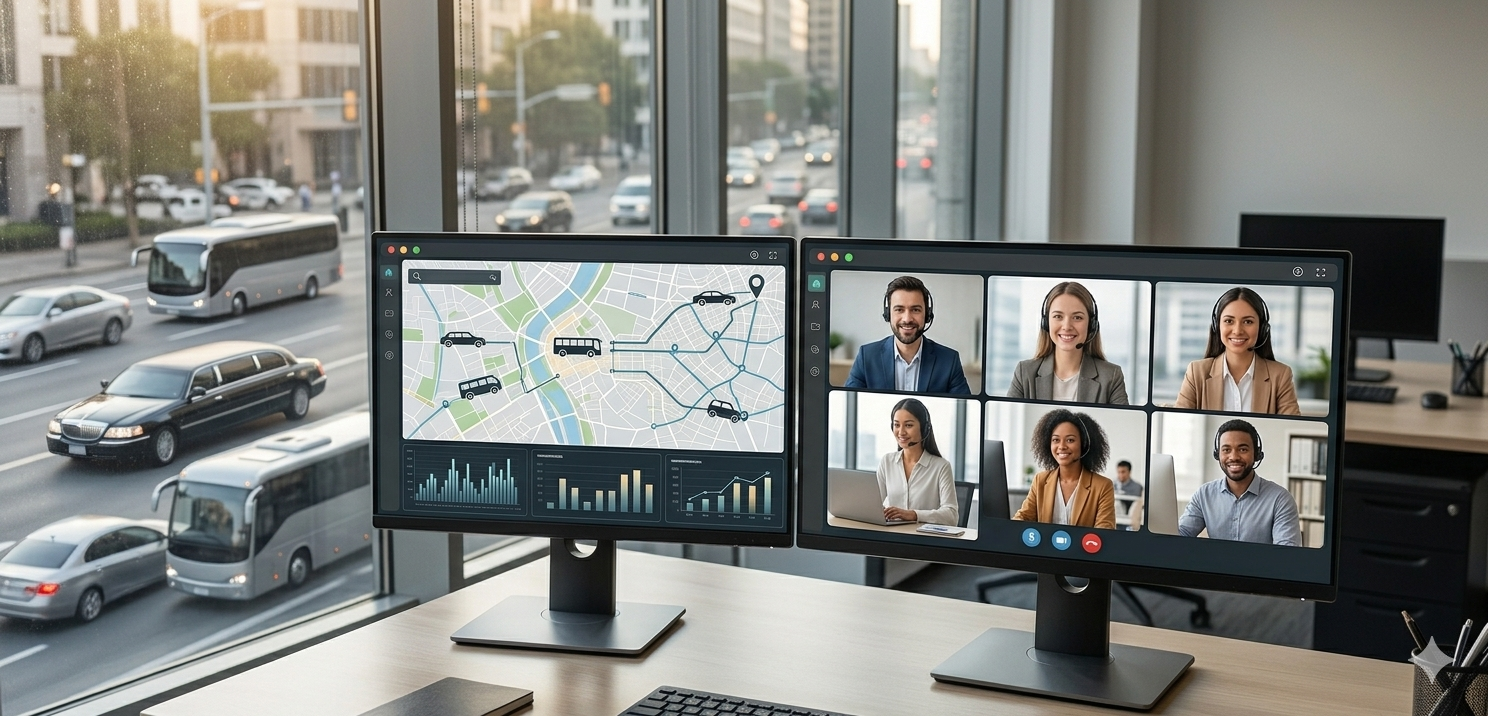
If you run a shuttle, black car, or limo company, you have probably been pitched by an overseas dispatch team. They answer your calls, take bookings, assign drivers, and handle customer communication, all for a fixed monthly fee. The value proposition is clear: you focus on operations, they handle the phones.
The question worth asking is whether AI can do the same thing cheaper and faster. Short answer: for most of it, yes. But not all of it.
This post breaks down what each option actually does, what it costs, and where the real trade-offs are, so you can make the call based on facts, not sales pitches.
What Outsourced Dispatch Teams Actually Do
Based on conversations with multiple overseas dispatch providers serving the U.S. ground transportation market, here is what a typical BPO dispatch team handles:
Call answering and booking intake. They answer your line 24/7, collect all the booking details: passenger name, phone number, pickup address, drop-off address, date, time, number of passengers, luggage count, and vehicle type preference. This is the core of the job.
Price quoting. They log into your dispatch software (Limo Anywhere, RouteGenie, or whatever you use), pull the rate for the route, and quote the caller directly. Some teams handle negotiation within a predefined range you set.
Credit card collection. They take payment information over the phone and process charges through your system. This requires PCI compliance and is one of the more sensitive parts of the operation.
Driver assignment. Using a priority list you provide, they assign drivers based on availability, proximity, or rotation rules. Communication with drivers happens over calls, texts, and WhatsApp, whatever your team uses.
Customer callbacks. They call passengers with ETAs, notify them when the driver is en route, and handle post-trip follow-ups if needed.
Affiliate and farm-out management. When you cannot cover a trip with your own fleet, they reach out to affiliate companies to farm out the job. This involves quoting, confirming, and coordinating with a third-party operator.
Platform management. Some teams manage your presence on booking platforms, accepting or declining ride requests that come through aggregators.
Typical pricing: $800 to $1,500 per month for after-hours coverage. Full 24/7 dispatch runs $1,100 and up. Onboarding takes 3 to 4 days, during which you provide protocol sheets, rate cards, driver rosters, and software credentials.
What AI Dispatch Handles Today
An AI dispatch agent built for ground transportation covers the inbound call side of that equation:
- 24/7 call answering. Every call picked up on the first ring, every time. No hold queues, no shift gaps, no sick days.
- Full booking intake. Passenger name, phone number, pickup and drop-off locations, date, time, number of passengers, luggage, vehicle type, flight number, airline, and terminal. The same fields your BPO team collects.
- Reservation lookup. Callers can check on an existing booking by providing a confirmation number or the phone number they booked with.
- Caller transfer to assigned driver. When a passenger needs to reach their driver directly, the AI connects the call.
- Instant notifications. Every new booking or inquiry triggers an email and SMS to you or your dispatch team in real time. No waiting for a shift report.
- Call recordings and full transcripts. Every interaction is recorded and transcribed. You can review exactly what was said, not a paraphrased summary.
- Consistent handling. The quality of the call at 3 AM is identical to the call at 3 PM. No training variance, no fatigue, no shortcuts.
Pricing: $49 per month. Live in 48 hours.
Head-to-Head Comparison
| Capability | Outsourced BPO | AI Dispatch (Caravan) |
|---|---|---|
| Monthly cost | $800 - $1,500 | $49 |
| Setup time | 3 - 4 days | 48 hours |
| 24/7 call answering | Yes | Yes |
| Booking intake (all fields) | Yes | Yes |
| Reservation lookup | Yes (manual) | Yes (instant) |
| Driver notification | Yes (calls/texts) | Yes (SMS + email) |
| Price quoting from software | Yes | No |
| Driver assignment | Yes | No |
| Affiliate / farm-out coordination | Yes | No |
| Credit card collection | Yes | No |
| Multi-line handling | Limited by staff | Unlimited simultaneous |
| Dashboard with transcripts | No (WhatsApp logs) | Yes (full dashboard) |
| Consistency across shifts | Varies | Identical every call |
| Call recordings | Rarely | Every call |
The pattern is clear. For inbound call handling and booking capture, both options cover the same ground. The divergence is on outbound coordination: assigning drivers, managing affiliates, and processing payments. That is where human dispatchers still hold the edge.
Where Human Dispatchers Still Win
Honesty matters here. There are things a human dispatch team does that AI cannot replicate today:
Complex multi-step coordination. When a driver calls in sick 20 minutes before a pickup, a human dispatcher redistributes that route across your available fleet in real time, weighing proximity, vehicle type, and driver hours. That requires judgment and context that goes beyond scripted call handling.
Real-time judgment calls. Assessing road closures, weather delays, passenger needs that do not fit a standard booking form, or deciding whether to hold a vehicle at the airport for a delayed flight. These are situational decisions that require human reasoning.
Affiliate network management. Maintaining relationships with farm-out partners, negotiating rates on the fly, and coordinating handoffs between companies, this is relationship-driven work.
Payment processing. Taking credit card numbers, processing charges, handling refunds, and managing disputes. This involves PCI-sensitive workflows that require human oversight.
These are real capabilities, not edge cases. If your operation depends heavily on any of them, a BPO team provides genuine value.
Where AI Wins
The advantages on the AI side are structural, not incremental:
Cost. $49 per month versus $800 to $1,500 per month. That is a 95% reduction in your phone answering costs. Over a year, the difference is $9,000 to $17,000 back in your pocket.
Availability. Truly 24/7 with zero gaps. No shift changes at 11 PM where calls go unanswered for 15 minutes. No holiday coverage negotiations. No call-outs.
Speed. Every call answered on the first ring. No hold queue, no “please hold while I transfer you.” The caller is talking within one second.
Consistency. The booking intake at 2 AM on a Sunday is handled with the same thoroughness as a Tuesday at 10 AM. No training variance, no new-hire learning curves, no fatigue at the end of a 12-hour shift.
Scalability. Five calls come in at the same time? All five are answered simultaneously. A BPO team handles one call per agent, if three calls come in and two agents are on shift, someone waits.
Visibility. Full dashboard with every call logged, recorded, and transcribed. You can see exactly what happened on every interaction. Compare that to scrolling through a WhatsApp group thread trying to piece together what your overnight dispatcher told a passenger.
Zero ramp-up. No protocol sheets to write. No 3-day onboarding period. No retraining when your BPO team has turnover. You configure your business details once and the system is live.
The Practical Middle Ground
For most small ground transportation operators running 5 to 15 vehicles, AI dispatch covers 80% or more of inbound call needs. The booking intakes, reservation lookups, driver transfers, and after-hours answering that make up the bulk of your call volume are handled automatically.
The remaining 20%, complex trip coordination, payment collection, affiliate management, and the judgment calls that come with active dispatch are handled by you or your existing team during business hours.
At $49 per month versus $1,100 per month, you are saving over $12,000 per year. And you are only personally handling the calls that genuinely require a human touch.
The math changes the equation for small operators who could never justify $1,100 per month for outsourced dispatch but are still losing bookings to unanswered after-hours calls. At $49, the barrier disappears.
For operators currently using a BPO team, the move is not necessarily about replacing them entirely. It is about recognizing that a large portion of what you are paying for, answering phones and capturing booking details, can be handled at a fraction of the cost. You can scale back your BPO hours, reduce your plan, or shift their focus to the high-value coordination work that actually requires a human.
Try It and Compare
If you are paying $800 to $1,500 per month for an overseas dispatch team to answer your phones, the simplest test is a side-by-side. Run Caravan on your after-hours calls for 14 days. Review the transcripts, check the booking details captured, and compare the experience to what your current team delivers on those same calls.
The cost difference speaks for itself. The question is whether the call quality holds up. We think it does, but you should see it on your own calls before you decide.